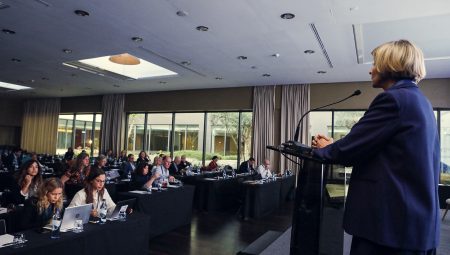

Held as a hybrid conference from 13 to 16 June, the European Human Genetics Conference (ESHG) brought together researchers, clinicians, diagnostic laboratories and other actors working across human genetics. According to information shared with ERDERA after the meeting, the 2026 edition drew more than 6,000 participants and received more than 3,100 abstract submissions, the highest abstract volume reported for the conference to date.
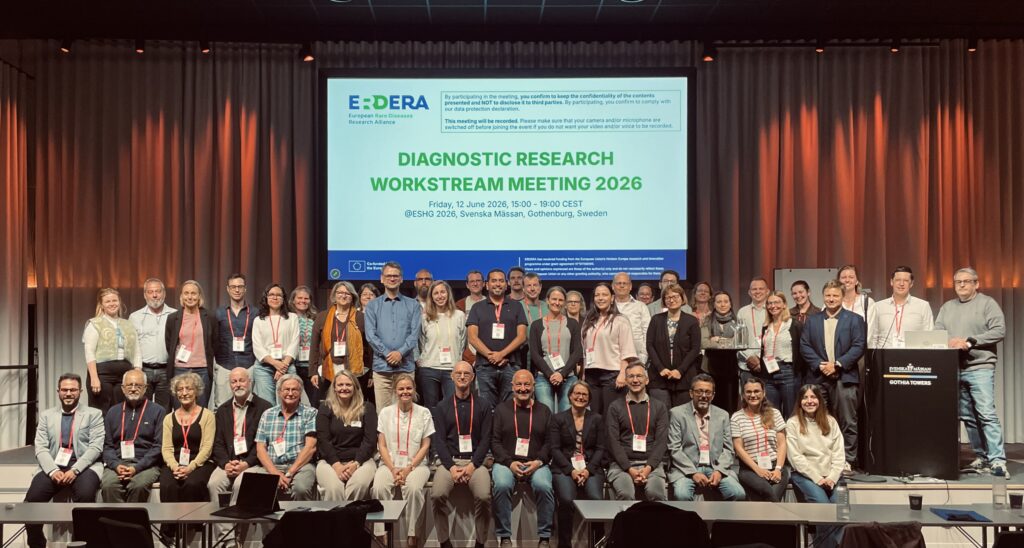
The event included the annual meeting of the ERDERA Diagnostic Research Workstream, which, according to attendees, brought together nearly 100 participants on site and online. The meeting reviewed progress to date, marked the first solved rare disease cases emerging from the workstream, and examined the next areas of work.
For patients and families who have waited years without a diagnosis, each solved case is significant. A diagnosis does not in itself alter every clinical outcome, but it can help clarify prognosis, inform genetic counselling, support more appropriate specialist follow-up and, in some cases, guide access to research studies or treatment pathways.
Scientific contributions in a changing diagnostic landscape
Alongside the annual meeting, ERDERA consortium members contributed to the wider ESHG programme in several capacities. The topics associated with those contributions were consistent with current priorities in rare disease diagnostics, including cross-network collaboration, earlier genetic detection, systematic reanalysis, transcriptomic interpretation and improved detection of technically challenging variant classes.
ERDERA’s diagnostics work similarly focuses on data sharing, structured reanalysis, long-read sequencing, optical genome mapping and RNA-based approaches. Taken together, these themes reflected current efforts in rare disease diagnostics to combine methods, re-evaluate existing data and link laboratory findings more closely to disease-specific expertise across centres.
Feedback shared after the meeting pointed to a conference with a strongly international abstract programme, visible early-career participation and an increasing emphasis on translational relevance. In post-meeting remarks, Scientific Programme Committee chair Alexandre Hoischen highlighted the strength of the science presented, the visibility of younger researchers and the collaborative atmosphere of the meeting, while indicating that attention was already turning towards the upcoming ESHG 2027 in Rotterdam.
For unresolved cases, the relevance of this work lies in whether such approaches improve the quality and consistency of evaluation when standard testing has not produced a clear result, and whether expertise from more than one country or centre can be brought to bear on difficult cases.
What comes after ESHG 2026
Following Gothenburg, ERDERA has set out the next areas of work as data sharing and ethics, systematic reanalysis, long-read sequencing and optical genome mapping, RNA data interpretation, and a gradual move from distributed towards federated approaches.
The importance of this next phase will depend on whether these methods can be applied in ways that are robust, comparable across centres and relevant to unresolved cases in routine practice. That is a gradual process and depends not only on technical progress, but also on standards, data governance and sustained collaboration across countries.
In Gothenburg, the meeting provided a point of review for work already under way and a basis for the next stage of implementation. Attention will now shift to how these activities develop over the coming year, ahead of the next European Human Genetics Conference in Rotterdam, the Netherlands, on 12–15 June 2027.