Science to policy

Translating scientific evidence into rare disease policy

ERDERA is firmly committed to broadening access to knowledge and ensuring that valuable research findings are widely shared across the rare disease ecosystem. Through the careful synthesis of key scientific evidence and its alignment with major European and international policy frameworks, ERDERA produces policy briefs that act as an indispensable resource. These documents are designed to support well‑informed decision‑making at every relevant level, from local and national authorities to European institutions and global stakeholders.

In addition to guiding policy discussions, these briefs showcase the significant relevance and far‑reaching impact of ERDERA’s activities. They also underscore the importance and societal value of the research projects supported and funded by ERDERA throughout Europe, highlighting how this work contributes to a deeper understanding of rare diseases and fosters improved outcomes for patients, families, and healthcare systems alike.

Why is this relevant?

Sharing research findings and insights from both clinical practice and patient experience ensures that vital knowledge reaches those who can act on it. Robust evidence enables decision‑makers to understand real needs, set informed priorities, and allocate resources effectively. Ultimately, this leads to better diagnosis, treatment, and care for people living with rare conditions.

ERDERA's impact on policy

ERDERA elevates key research findings to policymakers, clarifies priority needs, and supports the development of coherent, evidence‑based solutions. This contribution plays a critical role in strengthening policy frameworks and enhancing outcomes for patients and health systems.

Shaping policy with evidence-based research

As a co-funded European partnership bringing together 180 public and private partners to advance research and innovation, ERDERA plays an important role at the science–policy interface in rare diseases, health and wider European competitiveness. Policy briefs help explain the relevance of research findings and knowledge to ongoing policy debates, and support ERDERA in articulating its position on proposed policy or regulatory changes, particularly at European level.

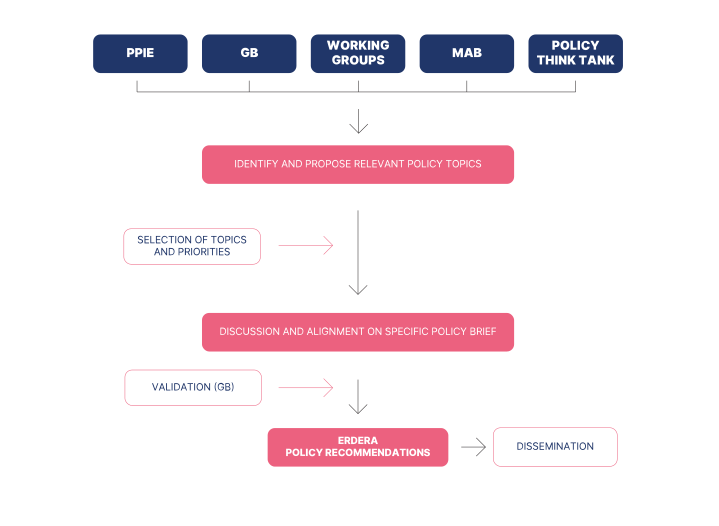
Alongside these explanatory briefs, ERDERA’s governance structure also supports the development of specific policy recommendations. In November 2025, following endorsement by the ERDERA Governing Board, the ERDERA Policy Think Tank was established as a neutral platform for evidence-based policy discussion and analysis, aligned with the European legislative calendar to help anticipate policy impacts.

The Think Tank aims to support ERDERA’s objectives by addressing policy issues on which the knowledge and experience of the ERDERA community — including researchers, clinicians, patients and policymakers — together with external stakeholders, can make a meaningful contribution. It is co-led by two chairs, one from the Governing Board and one from the Multistakeholder Advisory Board, and its work is carried out by a Steering Group of nine ERDERA members representing a range of internal stakeholder groups. Its activities are guided by a roadmap covering key policy areas such as data and clinical trials. The Think Tank is expected to hold two workshops each year, bringing together members and external experts to develop recommendations that translate research, knowledge and existing policy tools into concrete action. These recommendations will be submitted to the ERDERA Governing Board for endorsement before being shared with policymakers and other external stakeholders.

From policy to practice

Name of the policy brief

Lorem ipsum dolor sit amet, consectetur adipiscing elit. Ut elit tellus, luctus nec ullamcorper mattis, pulvinar dapibus leo.

Relevant publications

This study investigates possible measures that could be taken at EU level to address these challenges. It finds significant European added value in harmonising coordination and access across the 27 Member States, mainly in terms of improved diagnostic tools and availability of medical treatment, better health outcomes, particularly lower infant mortality, and improved well-being of family members and caregivers.
Published on 14 December, this WHO technical document maps global trends in registered clinical studies using human genomic technologies from 1990 to 2024, including patterns of inclusion and equity.
Open for consultation from 12 December to 12 April, this draft ICH guideline sets out how to design and submit robust patient preference studies to inform regulatory decision‑making across a medicine’s lifecycle.
With over 300 million people affected by rare diseases, timely access to effective therapies is critical. Despite strong alignment in regulatory expectations, patients in many regions face years of delays highlighting the need for improved international coordination.

Recent updates

“Patients are the glue that keeps all other stakeholders together—without them, the system simply does not exist”

ERDERA interviews Bojana Mirosavljevic, scientist and founder of the Život/Life association in Serbia; and one of the country’s leading voices rare disease patient advocacy.

“National Mirror Groups are essentially a bridge — bringing European developments, standards and opportunities to clinicians and researchers.”

ERDERA interviews Prof. Radka Kaneva and Dr Petia Stratieva, two leading members of Bulgaria’s National Mirror Group (NMG), to explore how the country is working to align its rare disease ecosystem with European developments.

Countries step up joint approaches to rare disease research at first in person ERDERA National Alignment Board meeting

Taking place at a pivotal moment – with the European Rare Disease Plan expected to move forward significantly during 2026 – the meetings brought together National Mirror Group (NMG) representatives from Europe and beyond, alongside European Commission stakeholders, IRDiRC and international partners.

European Parliament draft report urges a binding EU rare disease action framework

A legislative own initiative file in the Parliament’s new public health committee sets out what an EU “rare disease action framework” could look like — and why it could change how Europe measures progress for patients.