ERDERA Policy Brief: European Biotech Act

1:1
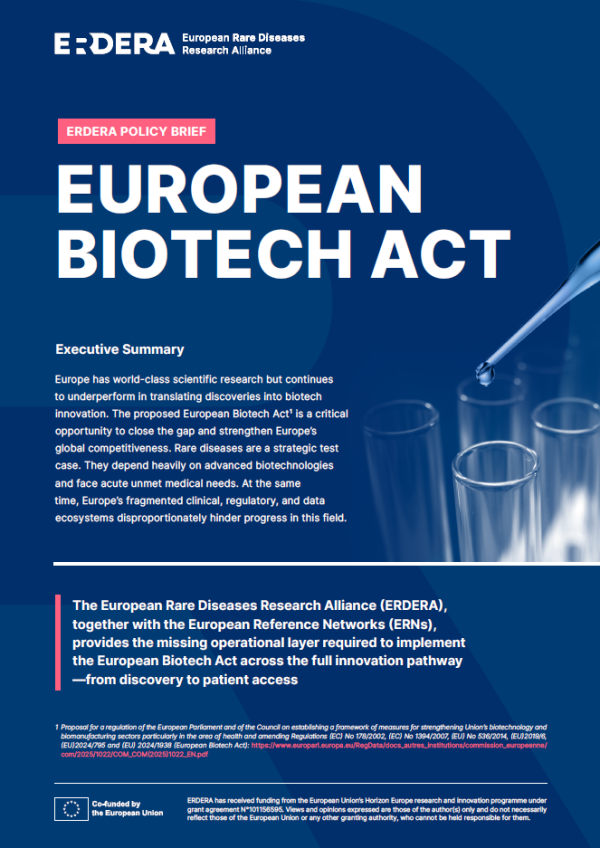
The European Rare Diseases Research Alliance (ERDERA), together with the European Reference Networks (ERNs), provides the missing operational layer required to implement the European Biotech Act across the full innovation pathway —from discovery to patient access.

This ERDERA policy brief frames rare diseases as a strategic test case for the proposed European Biotech Act, arguing that fragmented clinical, regulatory, and data ecosystems hinder translation from discovery to patient access. It identifies gaps in the draft Act (including limited recognition of existing infrastructures, narrow biotechnology scope, underdeveloped data frameworks, and skills shortages) and positions the combined ERDERA–European Reference Networks ecosystem as an operational backbone.

It provides seven policy recommendations spanning governance embedding, broader biotech definitions (including RNA, nanomedicine, and AI-enabled technologies), stronger interoperable data infrastructures, support for equitable multinational trials, skills initiatives, and improved investment conditions.

blank

publication

Year of publication

2026

Source

European Rare Diseases Research Alliance (ERDERA)

Author

You might also be interested in

ERDERA’s ethics and regulatory experts are launching a dedicated webinar series to help the rare disease research community navigate two fast-moving areas of biomedical research: Advanced Therapy Medicinal Products (ATMPs) and Artificial Intelligence.
July 24 @ 3:00 pm - 4:00 pm
This webinar will present a theoretical framework for situating ethics across research activities. The framework will then be brought to life through a relevant case study discussion, giving participants a concrete reference point for the episodes ahead.
This 2026 country report outlines the policy, research, care and support landscape for rare diseases in Poland.
Held in Riga on 9–10 June, the workshop brought National Mirror Group experts, researchers, clinicians and policymakers together to exchange practical lessons on how national rare disease registries can better support research and alignment across countries.