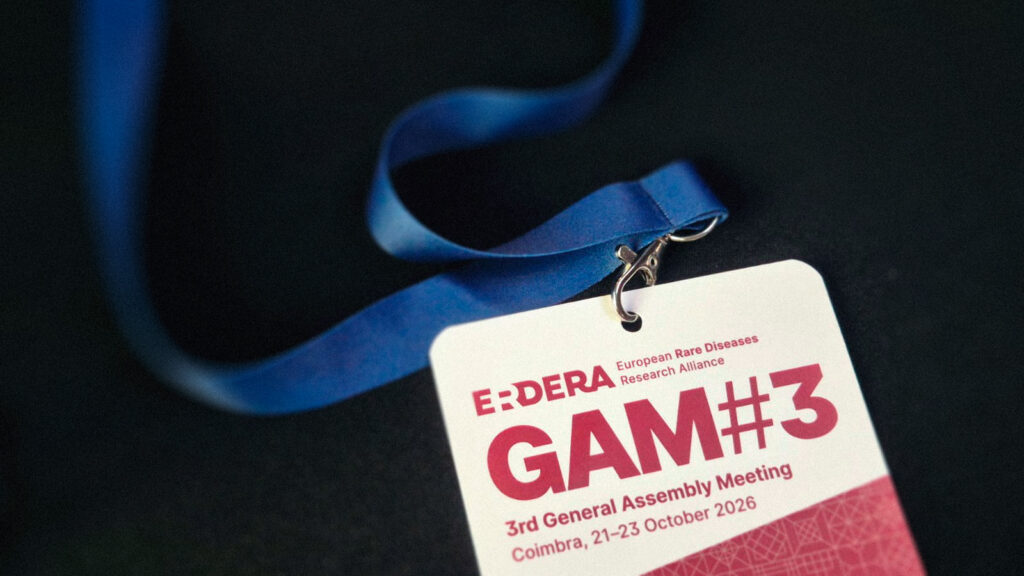
Over three days, partners reviewed the alliance’s second year and examined how its research, data, funding, training and expertise can work together more effectively in the next stage of implementation.
Hosted by the University of Coimbra, with support from Portugal’s Centro Region and the Coimbra Tourism Office, the meeting combined strategic discussions, plenary updates and focused breakout sessions. A recurring question linked the programme: how can the connections built during ERDERA’s first two years become practical support that researchers, clinicians and patient communities can use?
From building the partnership to putting it to work
The meeting opened with ERDERA’s Governing Board and Operating Group reviewing the partnership’s development, how its governance can respond to changing needs, and its role in European and international policy. Further sessions addressed coordination, financial management, communication and the long-term sustainability of its outputs.
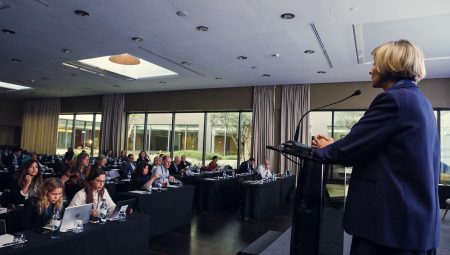
The review also offered a public account of progress. During the Open Session, which was broadcast live, ERDERA Coordinator Daria Julkowska reported that in the first two years, the partnership had brought together more than 23 000 diagnostic datasets from 26 partners in 16 countries, and that over 33 transnational research projects had been funded with nearly 50 million euros.
She also highlighted the clinical trial funding call, which combines investment with methodological, regulatory and patient expertise, alongside national cooperation through 24 National Mirror Groups.
“Look at the resources we mobilise, the expertise we share, and the work we make possible across borders,” she said.
That emphasis on what collaboration makes possible carried into discussions about Year 3. The progress review reported that ERDERA stands at 80% delivery for Year 2, providing a basis for the next stage. Building on this progress, discussions turned to increasing the reach and use of ERDERA’s results.
Partners examined how the partnership’s data, funding, services and expertise can support more research and demonstrate their value to the rare disease community.
European coordination and policy
The European perspective came from Tomasz Dylag of the European Commission’s Directorate-General for Research and Innovation, and Dusan Sandor, ERDERA’s project adviser at the European Health and Digital Executive Agency (HaDEA), which implements EU funding programmes.
Dylag connected continued research investment with the need to involve regulators and health technology assessment bodies early, so that studies generate evidence suited to decisions about treatments and their use in healthcare.
“For ERDERA, the next goal will be to translate this scientific progress into benefits for patients, for diagnostics, for treatments, and for improved quality of life,” he noted.
Discussions positioned ERDERA as a flagship for European cooperation in rare disease research, with a responsibility to demonstrate what sustained investment and shared expertise can deliver. That responsibility extends to making its resources useful beyond the partnership and contributing evidence to European and international policy discussions. The wider context is Horizon Europe’s growing international reach, with Canada, New Zealand and the Republic of Korea among its associated countries.
Connecting services, data and research
Plenary and breakout sessions explored how ERDERA’s Data Services Hub can support its Clinical Research Network and projects funded through its Joint Transnational Calls. Discussions covered data quality, connecting registries and biobanks, and preparing resources for analysis across institutions. A related exchange with the US Rare Diseases Clinical Research Network, supported by the National Center for Advancing Translational Sciences (NCATS), part of the US National Institutes of Health (NIH), explored complementary approaches to data harmonisation, evidence generation and research support.
The programme also examined how information from the last 20 years of Joint Transnational Call projects could become a searchable resource connecting projects, researchers, publications and funders. The purpose was to demonstrate the impact of that investment by bringing the funded work and its results into a connected view.
Training and education discussions considered shared learning modules and plans for an ERDERA Label linked to the European University Diploma in Rare Disease Research. A session on underrepresented countries examined practical ways to bring expertise from a wider geographical base into ERDERA’s activities and put that participation into practice.
Aligning around translational readiness
The final day brought scientific, data and methodological teams together around the steps needed to prepare promising research for clinical development. Discussions connected disease prioritisation, technology platforms, individualised therapies and the expert support needed to generate appropriate evidence.
The programme included a session on N-of-1 and N-of-few trials, designed for individual patients or very small groups, with shared study protocols, outcome measures and preparation for early regulatory discussions on its agenda. These discussions built on the public Open Session, which examined prion disease research, regulatory preparedness and European approaches to individualised treatments.
The closing session returned to the connections between these activities and the priorities for follow-up. For Year 3, the priority is to bring ERDERA’s activities fully into operation while securing their long-term value. That means demonstrating how researchers, clinicians and patient communities use the resources and expertise the partnership provides, and making sustainability part of delivery rather than a question left until the end.
As Julkowska put it during the event’s Open Session: “No country can do this alone and fragmentation is a cost we cannot afford. We must protect the continuity required to turn this progress into more benefits for patients.”