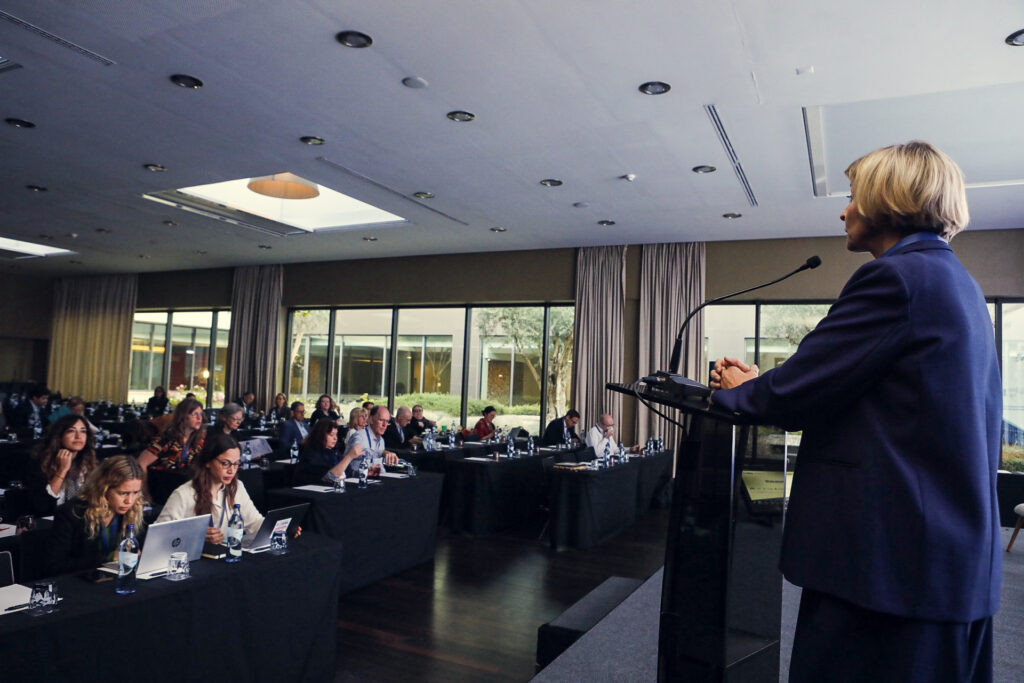
The European Rare Diseases Research Alliance (ERDERA) welcomed the rare disease community to the Open Session of its third General Assembly Meeting, held in Coimbra, Portugal, and online on 21 October. The programme linked the partnership’s second-year progress with the challenges of developing treatments for very small patient populations.
Opening contributions came from João Ramalho-Santos and Luís Pereira de Almeida of the University of Coimbra, ERDERA Coordinator Daria Julkowska, Tomasz Dylag of the European Commission’s Directorate-General for Research and Innovation, and Dusan Sandor, ERDERA’s project adviser at the European Health and Digital Executive Agency (HaDEA).
Dylag set out the partnership’s challenge: “For ERDERA, the next goal will be to translate this scientific progress into benefits for patients, for diagnostics, for treatments, and for improved quality of life.”
A second year focused on delivery
Julkowska reported that ERDERA had brought together more than 25 000 diagnostic datasets from 26 partners in 16 countries. She also highlighted the clinical trial funding call, combining investment with methodological, regulatory and patient expertise, and 24 National Mirror Groups connecting national communities with ERDERA.
“To develop a treatment for one person, you need the strength of an entire continent,” she said. Calling for continuity in national and European support, she added: “No country can do this alone and fragmentation is a cost we cannot afford. We must protect the continuity required to turn this progress into more benefits for patients.”
From personal risk to treatment development
Sonia Vallabh, Director of Prion Therapeutic Science at the Broad Institute, illustrated what that effort entails. Drawing on her experience as a person at genetic risk and a scientist, she described experimental therapies that lower prion protein and the evidence needed to bring them into trials.
Following dialogue with the US Food and Drug Administration, her investigator-led trial had recently opened recruitment to people who had not yet developed symptoms. Shared natural-history data, biomarkers and trial infrastructure could support future programmes, but she cautioned that clinical reality had not changed for most patients diagnosed today.
Following Vallabh’s account of regulatory dialogue in practice, Julian Beach, Executive Director for Operations at the UK Medicines and Healthcare products Regulatory Agency, offered the regulator’s perspective. Discussing the agency’s proposed rare therapies framework, he stressed that “proportionate doesn’t mean less rigorous”. Patient input and continued monitoring were central; reimbursement arrangements remained under discussion.
Shared approaches for individualised therapies
Bringing those scientific and regulatory questions together, Annemieke Aartsma-Rus, Professor of Translational Genetics at Leiden University Medical Center, presented ERDERA’s work on N-of-1 treatments, developed for individual patients. Published patient-evaluation criteria and consensus guidance support personalised antisense oligonucleotides (ASOs), medicines designed to act on RNA.
She outlined plans for platform trials studying different individualised treatments within a shared framework. Learning from each case requires usable data and realistic conversations with families: treatment may slow progression or address particular symptoms without offering a cure.
Her closing message brought the discussion back to the support surrounding any individual medicine: “Just having the ASO is not enough. You need to have guidelines and processes.” That commitment must extend beyond development: “You need to have a plan to continue the treatment and to monitor it.”
The recording and further information will be available through the ERDERA Open Session page.