ERDERA embeds Public and Patient Involvement and Engagement (PPIE) as a core, cross-cutting function within its governance and all work packages, ensuring that people living with rare diseases are involved as co-designers, implementers, and evaluators of research.
How PPIE is put into practice
Acts as the central coordination hub for patient involvement across the programme
Monitors work packages and works with their leaders to embed meaningful patient participation
Identifies where and how patients can contribute across the research lifecycle (design, calls, governance, dissemination)
Supports onboarding and capacity-building of patient advocates
Ensures research priorities, communication, training, and national alignment activities remain patient-centred
Overall, PPIE in ERDERA is not a standalone activity but a system-wide approach integrated into governance, funding processes, and research implementation.
These partners form a multi-organisation patient-led group that meets regularly and acts as the focal point for patient engagement across ERDERA.
International perspective
Funders such as the National Institute for Health and Care Research (NIHR), the Health Research Board (HRB) in Ireland, the Canadian Institutes of Health Research (CIHR) and the National Institutes of Health (NIH) increasingly expect meaningful PPIE in funded projects.
UK (NIHR): Global leader in embedding PPIE as a funding requirement
Canada (CIHR): “Patient-oriented research” model emphasising co-leadership
Ireland (HRCI): Strong focus on public involvement in health research strategy
Across these systems, the shared goal is co-production of research with those it is intended to benefit.
Key takeaway
ERDERA operationalises PPIE through a dedicated, patient-led coordination group embedded in governance, ensuring that patient perspectives systematically shape strategy, research design, funding, and implementation across the entire partnership.
Resources related to PPIE are available within the Learning Portal and can be accessed by applying the relevant filters.
Discover available resources
EURORDIS Black Pearl Awards to recognise rare disease community contributions in 2027
Established in 2012, the EURORDIS Black Pearl Awards recognise contributions across the rare disease community. The programme will return to Brussels and online on 15 February 2027.
European Blueprint sets out community priorities for a coordinated EU Action Plan on Rare Diseases
EURORDIS’ European Blueprint proposes 18 priority actions across six areas, offering a community-led foundation for a future EU Action Plan on Rare Diseases.
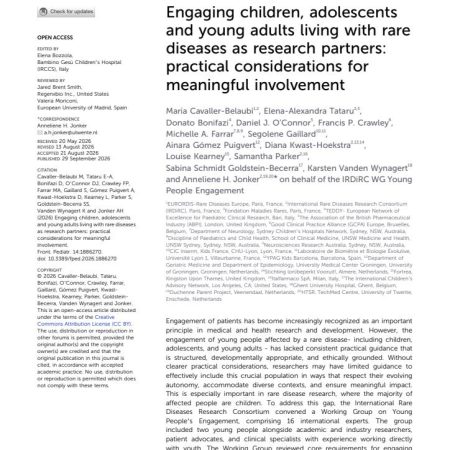
Engaging children, adolescents and young adults living with rare diseases as research partners: practical considerations for meaningful involvement
An International Rare Diseases Research Consortium (IRDiRC) working group developed practical guidance and a checklist for involving young people meaningfully in rare disease research.
Sweden adopts first national strategy for rare health conditions
Sweden has adopted its first national strategy for rare health conditions, aiming to improve coordination, equity and access to care between 2026 and 2030.
Open Academy x ERDERA Training on Data, Ethics and AI
Hybrid Open Academy x ERDERA training equipping rare disease advocates and early‑career researchers to navigate health data, ethics and AI in European rare disease research.
multi-format
•
intermediate
2026 | AI technologies | Data Collection and Sharing | Data Stewardship | Early Career Researchers | ERDERA | Ethics | EURORDIS–Rare Diseases Europe | Open Academy | Patient Advocacy | Regulatory
2nd ERDERA Training for Young Advocates for Rare Diseases
This training aims to empower young patients by providing them with the knowledge, confidence and skills needed to actively take part in paediatric and rare disease research.
Management of multinational clinical trials for rare diseases
Practical online course on planning and managing multinational clinical trials across Europe, including regulatory/ethics, roles, budgets, and patient engagement.
e-learning
•
basic
All rare diseases | Clinical research | Clinical Trials | ERDERA | Funding | Multinational trial management | Policy and Regulation | PPIE
Closed training
Materials available
Enhancing Patient-Centricity in Rare Disease Clinical Trials
This webinar explores patient-centred approaches to rare disease clinical trials, focusing on how patient priorities can be incorporated into trial design and analysis.
webinar
•
intermediate
Clinical Trials | Patient Advocacy | Patient engagement | Patient Public Involvement and Engagement (PPIE) | Ultra-rare diseases
Open Academy x ERDERA School on Scientific Innovation & Translational Research
The Open Academy School on Scientific Innovation & Translational Research is part of the Open Academy Schools x ERDERA and consists of a 4-day in-person training in Barcelona.
in-person training
•
intermediate
2027 | ERDERA | EURORDIS–Rare Diseases Europe | Innovation | Open Academy | Translational Research
Open Academy x ERDERA School on Medicines Research and Development
The School on Medicines Research & Development is part of the Open Academy Schools x ERDERA and is a 4-day face-to-face training, held in June in Barcelona.
in-person training
•
intermediate
2027 | Data Stewardship | ERDERA | EURORDIS–Rare Diseases Europe | Medicines Research and Development | Open Academy
Open Academy x ERDERA Training on Data, Ethics and AI
Hybrid Open Academy x ERDERA training equipping rare disease advocates and early‑career researchers to navigate health data, ethics and AI in European rare disease research.
multi-format
•
intermediate
2027 | AI technologies | Data Collection and Sharing | Data Stewardship | Early Career Researchers | ERDERA | Ethics | EURORDIS–Rare Diseases Europe | Open Academy | Patient Advocacy | Regulatory