
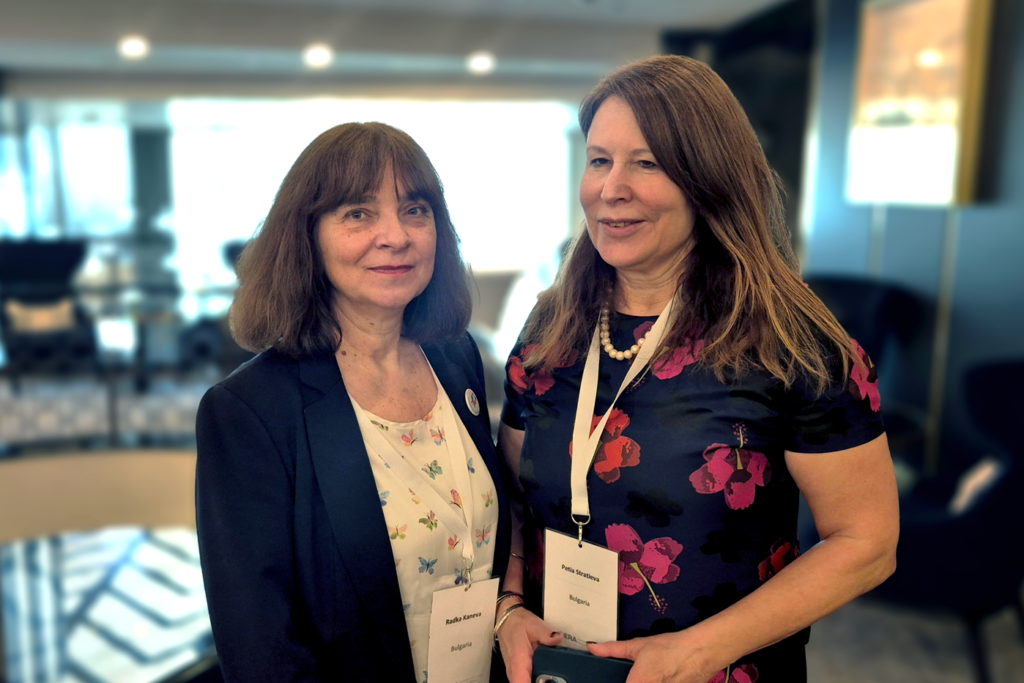
ERDERA met two of Bulgaria’s key rare disease leaders — Professor Radka Kaneva, a senior geneticist and long‑standing expert in rare disease diagnostics at the Medical University of Sofia, and Doctor Petia Stratieva, a leading patient advocate and co‑founder of Rare Diseases Bulgaria, the National Alliance of people with rare diseases.
Together they play central roles in Bulgaria’s National Mirror Group (NMG), bringing clinical, research and patient perspectives into a shared national forum. In this discussion, Prof. Kaneva and Dr Stratieva reflect on the opportunities and challenges facing Bulgaria’s rare disease ecosystem — and on how the NMG model is creating the conditions for long‑overdue progress.
ERDERA: To begin, could you explain the core purpose of the Bulgarian National Mirror Group? Why was it created, and why now?
Petia Stratieva (PS):
The National Mirror Group came about because ERDERA offered a unique opportunity that Bulgaria had not had before. It is a major European initiative involving nearly all Member States and all the European Reference Networks (ERNs).
Through it, we finally had a structured, coordinated way to bring all key stakeholders together around rare diseases. There had been discussions for years about forming such a group, but this was the first time common European guidance, tools, templates and procedures were provided for every country.
That made it possible to organise ourselves in a way aligned with our neighbours. And there was a real need, because the Bulgarian authorities had shown very limited activity in the field of rare diseases for many years.
E: Who exactly is represented in this multi‑stakeholder group? How broad is the participation?
PS:
On the clinical side, we have three categories. First, clinicians who already have long-standing ERN experience; they lead National Expert Centres that have been in the ERNs since 2017. Second, clinicians who lead National Expert Centres but who are not yet part of the ERNs and are not familiar with their processes. And third, clinicians who are not leading expert centres today and have no ERN involvement, but who have the potential to become National Expert Centres in the future.
On the research side, we also have several groups: researchers working in diagnostics and applied rare disease research, those involved in fundamental science through institutes like the Bulgarian Academy of Sciences, and researchers in public health and health technology assessment from the Faculty of Pharmacy in the Medical University of Sofia.
Then we have the patient community. Rare Diseases Bulgaria — the National Alliance for People with Rare Diseases — is represented, as well as Bulgaria’s ePAG (European Patient Advocacy Group) advocates, most of whom have years of experience in the ERNs. Patients are central to the NMG’s work and are co‑leading many activities.
From the authorities, we currently only have participation from the Ministry of Education and Science. This is a significant gap. We lack representation from the Ministry of Health, from the Rare Diseases Commission, and from the payers — including the National Health Insurance Fund. These are crucial because policy, regulation and reimbursement decisions depend on them.
E: You mentioned earlier that only around 200 rare diseases are formally recognised in Bulgaria. How does that affect the system?
Radka Kaneva (RK):
It has huge consequences. Bulgaria has a Rare Diseases Commission that must officially approve a condition before it can be diagnosed or treated in a recognised expert centre. There are more than 7 0000 rare disorders, yet Bulgaria recognises just 265 of them.
Progress is slow, and at this pace it will take decades to complete the list. Meanwhile, patients with unrecognised conditions find themselves in a kind of limbo: clinics cannot easily diagnose or treat them, and the health system covers basic care, while specialized diagnosis and treatment may not be.
E: Given these challenges, where do you see potential — clinically, scientifically, or structurally?
RK:
The potential is considerable. ERDERA allows us to connect Bulgaria to the wider European landscape. National Mirror Groups are essentially a bridge — bringing European developments, standards and opportunities to clinicians and researchers who might not otherwise be aware of them or able to participate.
Bulgaria currently has three organisations engaged in ERDERA: the Medical University of Sofia, the National Alliance of People with Rare Diseases “Rare Diseases Bulgaria”, and the National Science Fund.
The Ministry of Education and Science recognises the value of European cooperation and research consortia. This can be transformative, especially because national funding for rare disease research is limited. Through ERDERA, we can join European projects, receive training and share expertise.
PS:
And I want to highlight something: there is no other body in Bulgaria like the NMG. We are far behind European standards in rare disease policy. Bulgaria is among the five worst-performing countries in terms of ERN coverage. We are the only country with more than one million inhabitants that did not participate in the 2019 call for full ERN membership. We do not participate in eighteen out of twenty‑four ERNs. That affects patient care, research capacity, even access to innovation.
A major barrier is outdated legislation. Our national ordinance on rare diseases has not been updated since 2014 — before the ERNs even existed. The Rare Diseases Commission has also not been renewed in many years.
Meanwhile, we do have around 44 recognised National Expert Centres—so clinical expertise exists. But many expert centres either do not know how to join ERNs, or find the administrative burden too high. Helping them is one of the NMG’s key future priorities.
Even the expert centres already in ERNs are participating purely out of commitment, not because the system supports them. They receive no institutional recognition, no financial support—nothing. They do it because it is their mission.
E: It sounds like the NMG is trying to stabilise a system that has been left without coordination. Is a national strategy part of what you hope to achieve?
RK:
Yes. Our previous national programme ended in 2013. It was one of the earliest in Europe, but it was never renewed. Since then, the field has been driven by individual enthusiasm rather than coordinated policy. A national plan must align Bulgaria with European expectations.
If we look at it through the lens of the European Commission and the ERNs, they expect ERN coverage across all countries and all geographical regions—not only to improve healthcare but also to ensure steady data flows into ERN registries. These registries exist for all 24 ERNs and form the backbone of clinical research networks. But when countries do not participate, this becomes a major issue.
PS:
In Bulgaria, we have several expert centres working on the same diseases or within the same thematic areas, but their roles are not coordinated. Some are part of an ERN, others are not, and there is no national network of expert centres to bring them together. A national rare disease strategy would allow us to organise these centres in a structured way and link them more effectively with the European system.
The role of the National Mirror Group is to advocate for this national vision: a plan for improving care, improving research, and building a coordinated network of expert centres. To do this, we first need the Ministry of Health to commit. And to get that, we must also work with the Parliamentary Health Committee so they can request that the Ministry convene a group of experts tasked with writing a National Rare Disease Plan.
Otherwise, everything remains just “good intentions”.
E: This brings us to data. What does the data landscape for rare diseases look like in Bulgaria?
RK:
To be frank, we do not have reliable national data on rare diseases. There is no proper national rare disease registry, and the problem goes beyond rare diseases — we struggle even with the cancer registry. Data are fragmented across hospitals, insurance systems and genetic laboratories. Without standardised, unified data, it is impossible to plan services or conduct serious research.
The estimated number of rare disease patients is over 400 000. We still use ICD‑10, and Orphanet codes — which are essential for rare diseases — are not systematically applied.
Through ERDERA and the European Health Data Space, Bulgaria can align with European standards. We are also involved in the 1+ Million Genomes initiative, which promotes cross‑border access to genomic data for research. Rare diseases would greatly benefit from this. Our university has joined the Clinical Research Network for undiagnosed cases in ERDERA, which is a major opportunity.
But participation brings responsibilities: proper data‑sharing agreements, GDPR compliance and adoption of FAIR principles. The NMG can help raise awareness and secure support from government and the national health insurance fund. Integrating Orphanet coding and rare disease data into electronic health records would be an important step, especially since Bulgaria must join the European Health Data Space by 2029.
E: Let’s move from systems to lived experience. What is life like for a rare disease patient in Bulgaria?
RK:
The system is held together by patients and patient organisations. They know exactly what is missing. Early and accurate diagnosis is the biggest need. But diagnosis often takes years because clinicians are not familiar with rare diseases, so people are passed from one specialist to another before being referred for genetic testing.
Genetic diagnosis for children is funded, but only partially, and only up to age eighteen. Adults must pay out of pocket. That is a major injustice. We recently established a contract with the main paediatric hospital in Sofia, which has improved referral times for children, but services for adults remain very limited.
PS:
Access to care is also problematic. Without designated expert centres, clinicians often do not know where to refer patients. In some disease areas, Bulgaria has only one centre for a single condition, and patients are frequently sent abroad, often to Türkiye.
Participation in ERNs is essential because it provides access to clinical management systems and virtual clinics — key mechanisms for high-quality, cross‑border care. Bulgarian centres outside the ERNs cannot access these tools.
And then there is access to clinical trials. Without registries, Bulgarian patients remain invisible. Clinical trials are often the only way to obtain emerging treatments. So for diagnostics, care, treatment and future therapies, Bulgarian patients are significantly behind their counterparts in Western Europe. The East–West gap is very real.
E: Europe is now preparing a European Rare Disease Plan. How could such a plan help Bulgaria?
PS:
A European plan would be extremely valuable. It creates a shared framework and, importantly, common key performance indicators that allow countries to track progress consistently. For Bulgaria, which lacks a national plan, these pillars would be essential for building one. It mirrors what happened with the European Beating Cancer Plan, which prompted Bulgaria to create its own cancer plan — even if implementation is still incomplete.
The important difference this time is that the NMG exists. It brings all stakeholders together — clinicians, researchers, and patients — which makes it possible to reach consensus on priorities. We can start working immediately. We can form working groups on registries, Orphanet coding, newborn screening, and the national plan itself. We do not need to wait passively for the European plan to be finalised.
RK:
Ultimately, this is not just another strategy. It is about reorganising our healthcare system so that diagnosis happens earlier, stakeholders collaborate effectively, and Bulgarian patients progress alongside the rest of Europe. Rare diseases cannot be addressed in isolation.
Without alignment with European initiatives, we will keep producing scattered good examples but not systemic progress. A European plan gives us the foundation; the NMG gives us the mechanism. Together, they offer a real opportunity for change.