
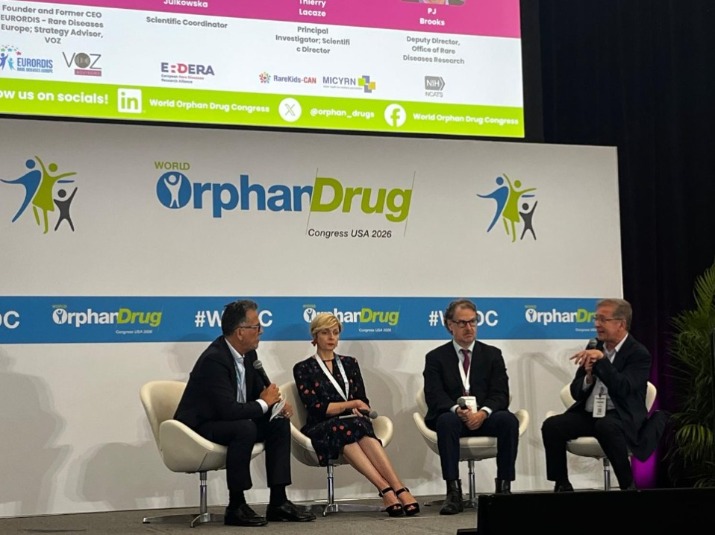
From From 9 to 11 June 2026 in Boston, the World Orphan Drug Congress USA brought together stakeholders working across rare disease research, regulation, medicines development and patient advocacy. The European Rare Diseases Research Alliance (ERDERA) was represented by its Scientific Coordinator, Daria Julkowska, who used the congress to underline a practical point: for many rare diseases, trials become feasible only when sites are connected well enough to recruit and work in a coordinated way across borders.
That challenge is structural: when patient populations are small and geographically dispersed, a single hospital or even a single country will often struggle to enrol enough participants for a robust study. Trial teams therefore need ways to identify eligible patients across several centres and generate evidence that can be compared and interpreted with confidence.
What emerged from the discussion in Boston
Julkowska’s first panel highlighted a second issue alongside trial feasibility: clinical research networks are still not as visible or as well understood as they should be, even when they have existed for many years. Drawing on exchanges with long-established rare disease clinical research networks in the United States and with Canadian partners involved in ERDERA, she pointed to a shared challenge across systems: these structures can remain underused when their organisation, capabilities and practical value are not clear enough to the wider field.
“In rare diseases, feasibility is often the first scientific question,” said Daria Julkowska. “A study may be well designed on paper, but it will not deliver if the right patients cannot be reached across enough sites. What was also striking in Boston was that even networks with more than 20 years of experience can still be underused because their structure and the value they bring are not always well understood.”
She added that the discussion showed how much mutual learning is possible across networks. Experience built in North America has helped inform parts of ERDERA’s thinking, while collaboration with Canadian partners already involved in the alliance points to the value of stronger international exchange around how clinical research networks are organised and used.
What ERDERA brought to the discussion
In Boston, ERDERA’s contribution was to frame network-building as practical research infrastructure. ERDERA’s Clinical Research Network is being developed as a pan-European ecosystem that connects European Reference Networks, national diagnostic centres and undiagnosed disease programmes, with shared access to harmonised data, re-analysis pipelines and innovative trial platforms. The aim is to make rare disease research more interoperable across borders and more usable for diagnosis, outcome research and innovative therapies.
This matters scientifically as well as operationally. Shared infrastructure can help studies move beyond isolated datasets or single-centre experience, while common approaches to outcome research can improve how trials capture the impact of a disease or a treatment on patients’ lives. That is especially relevant in rare diseases, where conventional trial models are often difficult to apply in very small populations.
From innovation to access
A later panel broadened the discussion from trial design to the conditions required for treatments to reach patients. Speakers returned to a familiar tension in rare diseases: standard development and assessment models do not always fit small populations or highly heterogeneous conditions. While regulators are increasingly open to innovative approaches, bringing treatments to patients still depends on generating evidence that can also satisfy health technology assessment (HTA) bodies and support access decisions.
“Bringing treatments to rare disease patients requires openness, innovation and collaboration, because standard approaches will not always work in small and heterogeneous populations,” Julkowska said. “Patient partnerships in research are becoming a new normal, but we still need to integrate the HTA perspective much earlier. Education, trust and collaboration across all stakeholders are essential if rare disease treatments are to make their way to patients.”
That point connects directly to ERDERA’s wider approach. Building better trials is one part of the task, but so is creating a research environment in which patients, regulators, assessors, clinicians, researchers and developers are involved early enough for promising methods and evidence strategies to be understood across the pathway.
For patients and families, the value of this work is concrete. A trial that can recruit across countries is more likely to reach the numbers it needs, stay on a realistic timetable and generate evidence that can support later decisions on treatment development and access. In Boston, the broader message was therefore not only that networks matter, but that they need to be better understood, more visible and more connected to one another if they are to be used to their full potential.