
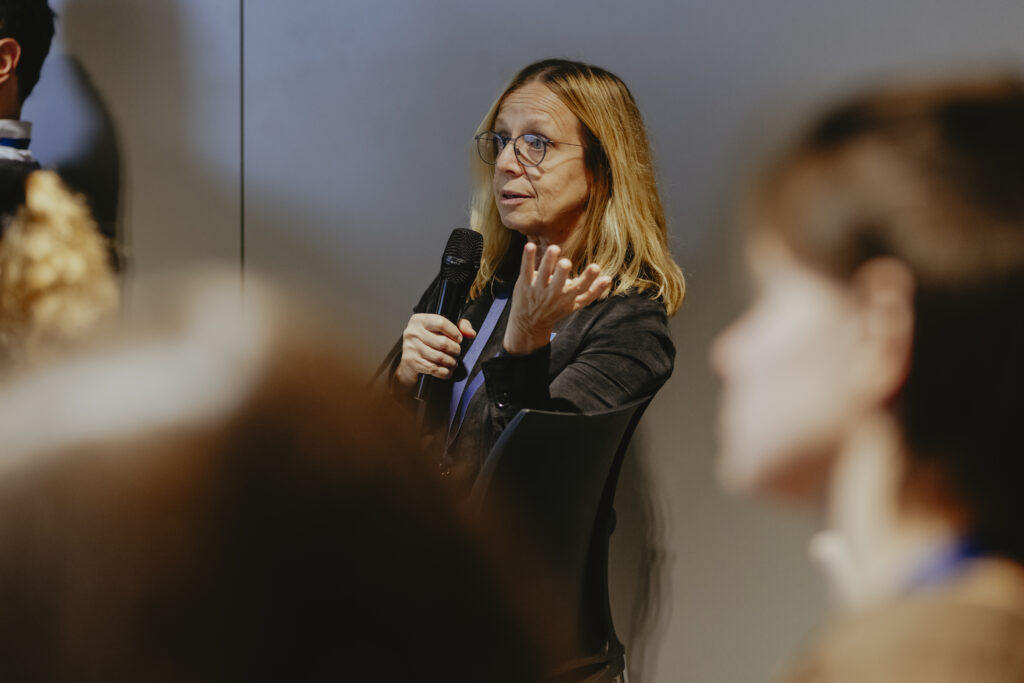
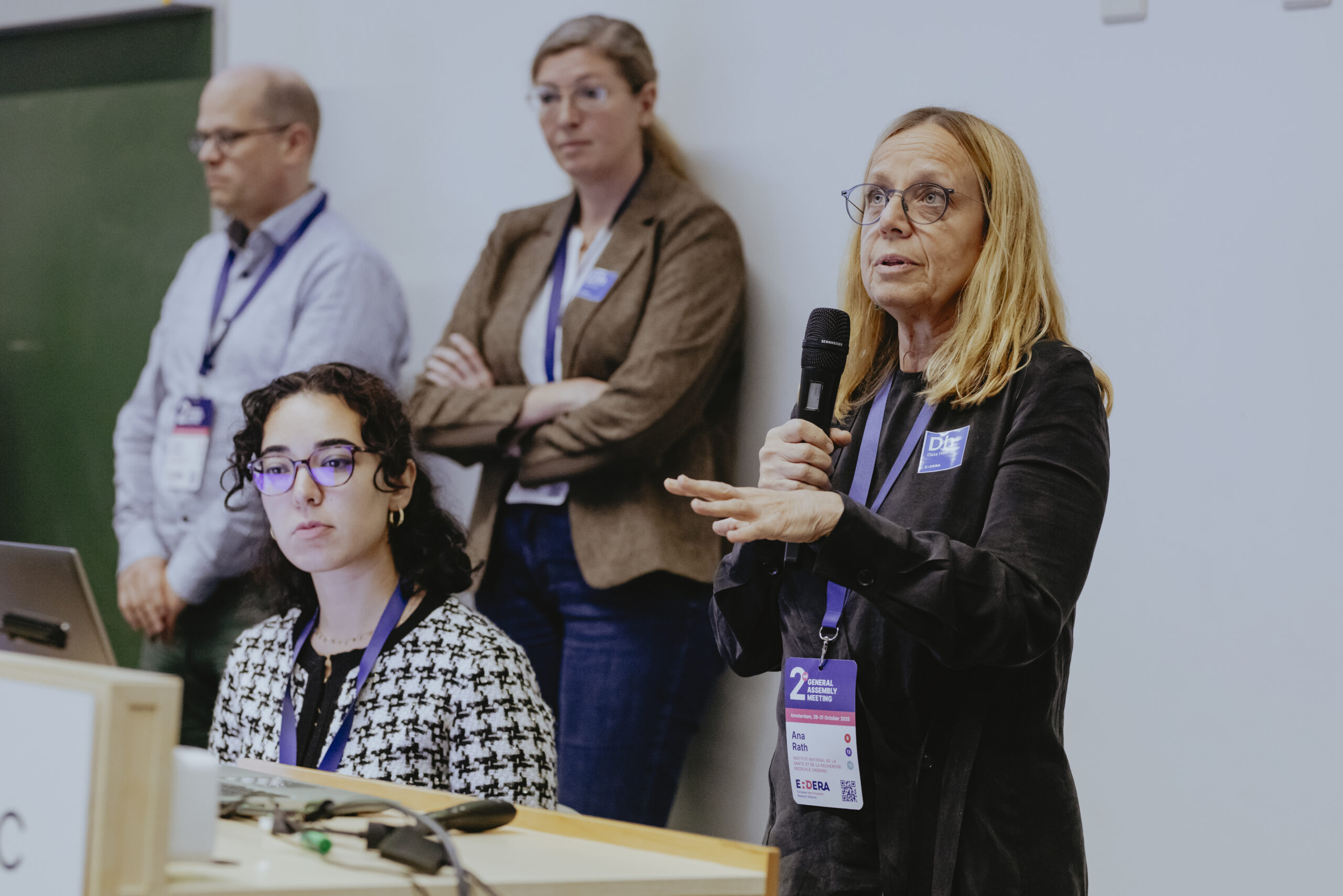
Ana Rath is a medical doctor and specialist in rare disease information and terminology who has led Orphanet and coordinated its network since 2014. She chairs the Orphanet Rare Disease Ontology and works on the implementation of rare disease coding and data standardisation across Europe.
Within ERDERA, she co-leads the Data Service Hub, which brings together expertise, methodologies, standards and tools to help rare disease data become easier to discover, understand, connect and reuse for research.
It seems that data plays a key role across ERDERA. How would you define data in the context of research on rare diseases?
Data can be understood as words that become the individual entries in a dictionary. At first, they may appear as isolated elements, each carrying only partial information. However, when they are properly described and organised according to certain rules, they start to build a clearer picture and reveal meaning.
In this sense, data are both the starting point and the outcome of research — they allow us to define, interpret and continuously refine our understanding of rare diseases.
Building on this, ERDERA works to create the equivalent of well-structured data-resources, along with the tools needed to interpret them. This means ensuring that data are described in a consistent way, organised using shared standards, and connected through common “languages” so that they can be understood, combined and reused across different contexts. By doing so, we intend to increase the value of data and make them more ready to support research.
Seeing it like this, it is clear that data plays a central role in rare disease research, yet it is very sensitive. What are the main constraints when managing data?
There are several key considerations. Rare disease research relies on data from many different sources, which means we need to be sure that information is handled responsibly and in a way that respects patients’ privacy and confidentiality. At the same time, data holders need to retain control over their data and operate within regulatory frameworks such as GDPR.
Another important challenge is making sure that data collected in different places can be understood and used together, which requires common standards and a high level of trust between all those involved. These foundations are essential if we want data to be reused effectively.
And so what would you say is the ERDERA Data Service Hub?
So, the Data Service Hub is, first of all, a team of data experts that will help researchers or data holders to improve their data and the reuse of their data for future research on rare diseases.
And then it’s a set of methodologies, best practices, technical tools, and standards in order that every data asset, a registry, a biobank, or a data collection is, let’s say, better shaped to enter an ecosystem and to be reusable by researchers in the future.
So not only will projects, for instance a funded project or a clinical research network that is conducting research, manage their own data more efficiently, but they will prepare their data to make value out of it and to be reused in the future because that will be part of a data ecosystem we are building for rare disease research.
What types of services does the ERDERA Service Hub provide to researchers and data holders?
To continue with the analogy, just as a dictionary helps people find the right word, understand its meaning and relate it to other concepts, we help data become easier to find, access, combine and reuse. To achieve it, we identify the elements that are needed, organise them appropriately, and ensure they can work together effectively. This idea is captured by the FAIR principles: making data Findable, Accessible, Interoperable and Reusable. And so we provide services that echo such principles.
For instance, if you have a registry or a biobank and you would like others to know that your data exist —what disease does it cover, or how many people are included — you can create a way to make this visible without compromising the data’s privacy. You’re hinting the message, yet you’re not necessarily displaying the full text.
Beyond this visibility, we also help data holders adapt their data so it can be reused, both by themselves and by others. This includes managing access conditions — who can access the data, under which conditions, and for what purposes. Importantly, data holders always remain fully in control of their data. The aim is to improve data quality and, ultimately, the quality of the research that relies on them.
In some cases, you may want to analyse your data together with data from other sources. ERDERA is working to provide services that enable this — either by combining datasets or by keeping each dataset at its original location and analysing them in a federated way. In this model, the data does not move, but analysis can still be carried out across sites.
Finally, we provide what we call reference data. This may include data that allow researchers to analyse diseases by its prevalence, or group diseases by phenotype, assess their functional impact on patients’ daily lives, or to better understand disease mechanisms. These curated reference datasets can be used alongside researchers’ own data.
Building on what you’ve just described, why is this way of handling and connecting data so important for rare disease research?
This is important because rare disease research cannot advance in isolation. By handling data in a structured and responsible way, we can build a shared European ecosystem where knowledge, expertise and data can contribute to a bigger picture. This improves the quality and comparability of research, enables data reuse while respecting ethical and governance requirements, and ensures that valuable datasets continue generating insights beyond individual projects. Ultimately, this helps accelerate the translation of research into benefits for patients and healthcare systems.
What are the next ERDERA goals in the field of Data?
We still see many opportunities to improve the way data can be discovered, understood and used across the rare disease community. A key focus will be continuing to harmonise datasets so that information collected in different contexts can work together more effectively. We also want to keep enhancing the Virtual Platform, making it easier for researchers to find and explore relevant rare disease data resources.
Another important area is helping make data more accessible for research, always within appropriate ethical and legal frameworks. At the same time, we want to continue raising awareness of the value of high-quality and FAIR data, and encouraging good practices across the community. Ultimately, our aim is to help build a more connected and sustainable data ecosystem that can support rare disease research in the long term.