
- Today ERDERA opens its 2026 Joint Transnational Call, “Resolving unsolved cases in rare genetic and non genetic diseases”.
- Multinational research teams can now prepare proposals focused on delivering diagnostic clarity for people living with rare conditions who still lack a clear explanation for their symptoms.
- The full call text, national and regional annexes and links to the online submission system are available on the Joint Transnational Call 2026 page.
What the call funds
The scheme supports interdisciplinary research that identifies causative variants in undiagnosed rare genetic diseases and addresses complex, multifactorial non genetic rare diseases, including individuals who remain without a molecular diagnosis after earlier genetic or genomic testing.
Projects are expected to develop or apply approaches such as functional validation of variants of uncertain significance, integrative multi omics, advanced bioinformatics and AI enabled annotation, systems biology, disease mechanism modelling and the integration of clinical, environmental, lifestyle and sensor derived data. Work on pre clinical therapy development or interventional clinical trials is outside the scope of this call.
By prioritising robust analytical methods and data driven approaches, the call aims to shorten the diagnostic journey and generate evidence that can be translated into better care through ERDERA’s Clinical Research Network, Data Services Hub and Expertise Services Hub.
Who can apply and how consortia are organised
Subject to national and regional eligibility rules, the call is open to researchers based in academic institutions, hospitals and public health organisations, enterprises of all sizes (with a particular encouragement for SMEs) and patient advocacy organisations.
Only transnational projects are eligible. Consortia must include between four and six eligible principal investigator partners from at least four different countries participating in the call, with no more than two eligible partners per country.
In specific cases, consortia may be allowed to grow to eight partners, as described in the call text. Patient partners, whether funded or unfunded, are strongly encouraged from the outset but do not count towards the partner limits.
A coordinator based in a country or region participating in ERDERA’s 2026 Joint Transnational Call will lead the consortium and act as the main contact point for scientific reporting.
Collaborators using their own resources and subcontractors allowed under national rules may also participate; these roles do not count towards the partner caps but must be clearly described in the proposal. Funding organisations from more than twenty countries across Europe and Canada are taking part; the full list and any specific restrictions are provided in the national and regional annexes.
Key process and timeline
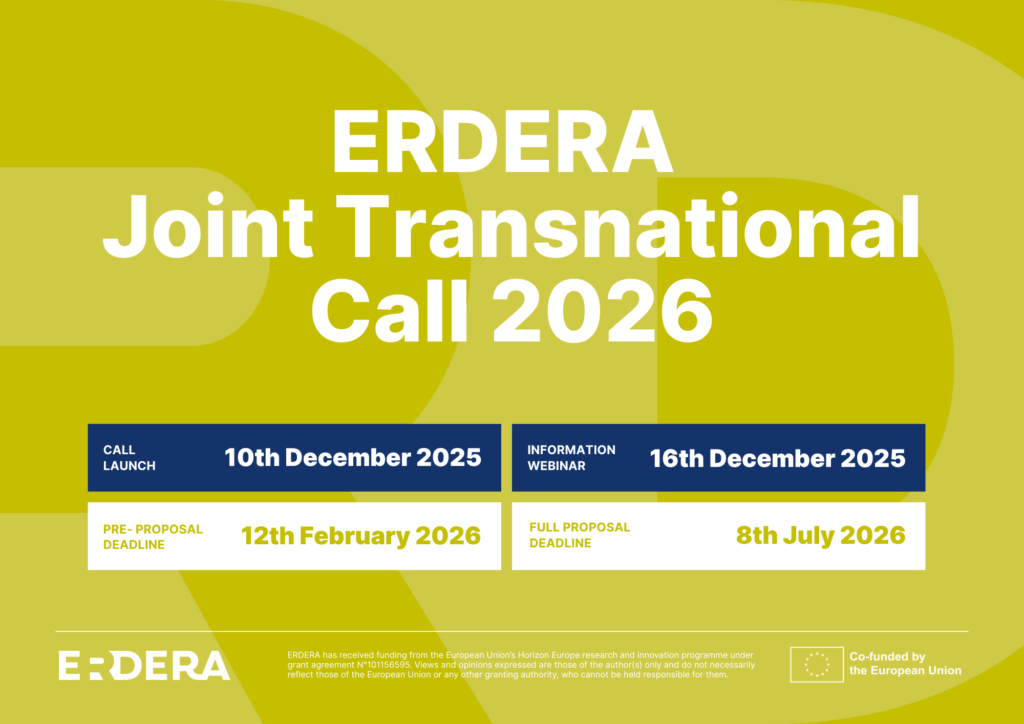
From today, applicants can access the call documents, set up a consortium and prepare their preproposal in the electronic submission system. The preproposal deadline is planned for 12 February 2026, followed by eligibility checks and invitations to successful consortia to submit full proposals in early May. Full proposals are expected by 8 July 2026, with funding decisions foreseen for December 2026.
An online, limited information webinar for applicants will take place on 16 December 2025, 15:00–17:00 CET, to explain the call scope, evaluation process and national requirements, and to answer practical questions about submission.
A second webinar is planned for invited full proposal coordinators in May.
For people living with rare diseases and their families, this call represents a concrete step towards earlier and more accurate diagnosis through collaborative European research and beyond. All binding information on eligibility, timelines, submission and evaluation is set out in the official call text and national and regional annexes on the Joint Transnational Call 2026 page.