
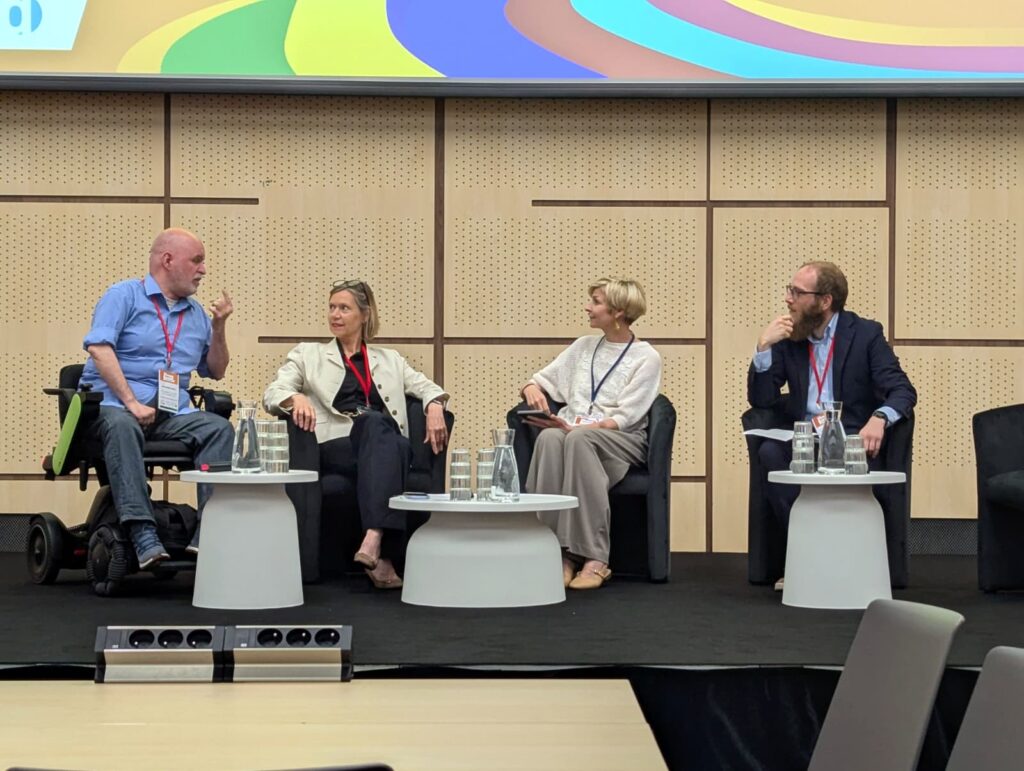
The 13th European Conference on Rare Diseases & Orphan Products (ECRD 2026), organised by EURORDIS–Rare Diseases Europe and co-organised by Orphanet, convened the rare disease community in Prague and online on 3–4 June. Under the theme “Rare Diseases in a Changing & Competitive Europe”, the conference brought patient advocates, healthcare professionals, researchers, policymakers, regulators and industry into the same room — with a patient-centred bottom line: progress must be measured by whether people living with rare diseases and their families receive timely diagnosis, quality care and fair access to innovation, wherever they live in Europe.
This edition took place at a moment of growing political attention. New EURORDIS Chief Executive Officer Jean Saslawsky opened his mandate by signalling a listening posture over the two days — to patients and families first, alongside clinicians, researchers, advocates, policymakers and partners. The opening plenary reinforced a point that surfaced repeatedly across the programme: rare diseases are a clear test case for EU added value, because no single country can solve fragmentation alone — not in expertise, not in data, not in trials, and not in access.
From Blueprint to implementation: a plan that can be used
A key milestone came the day before the conference, with a dedicated workshop that presented and refined the European Blueprint for Rare Diseases. Designed as a practical foundation for an EU Action Plan, the Blueprint aims to consolidate existing initiatives, identify gaps, and translate shared intent into recommendations that can be implemented. Its publication is planned for September 2026 — and ECRD’s role was to sharpen what “delivery” should look like in practice: clearer guidance, stronger coordination, and accountability that keeps patients at the centre rather than at the margins.
The conference also made the “from discussion to action” challenge unusually concrete. A closed high-level meeting hosted alongside ECRD brought together ministers and senior officials from 14 Member States under Chatham House rules, reflecting a shared view that an EU-level plan should strengthen — not replace — national strategies, while improving coherence, ambition and follow-through across countries.
What stakeholders aligned on — and where access still stalls
Across sessions, earlier and more accurate diagnosis remained one of the most persistent unmet needs. Discussions on early detection and newborn screening underlined that these are programmes, not single tests: feasibility and scalability matter, but so do counselling, follow-up and equity. In parallel, sessions on holistic care and specialised healthcare returned to a simple gap in many systems: what is not measured is often not managed. Speakers highlighted the need for better, more consistent evidence across Europe — including registries and shared approaches that capture outcomes that matter to patients, not only what is easiest to count.
For ERDERA, ECRD 2026 was also a reminder of how much alignment now exists across stakeholder groups — and of what still blocks patients from benefiting. ERDERA’s Scientific Coordinator Daria Julkowska reflected that “the alignment among speakers was tangible — patients, industry, regulators and the research community are increasingly pulling in the same direction.” She also captured the sticking point that came up repeatedly when discussions turned to access: “Regulators are increasingly open to dialogue and innovation, but we are not yet there on health technology assessment. That gap still slows down access for patients.” She added a systems-level lesson from the conference debates: research, regulation, assessment and care must be treated as one connected pipeline, so that scientific progress translates more reliably into patient benefit rather than getting lost between silos.
Looking ahead, ECRD 2026 sets a clear sequence of next steps: consolidate stakeholder input into the Blueprint ahead of September’s publication, keep political momentum anchored in patient outcomes, and move faster from agreed principles to implementable guidance.