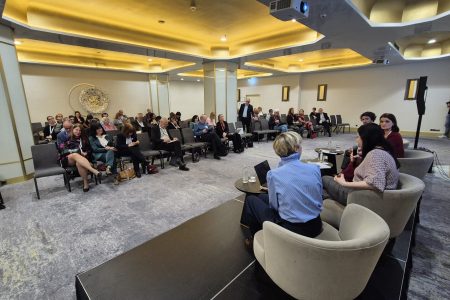

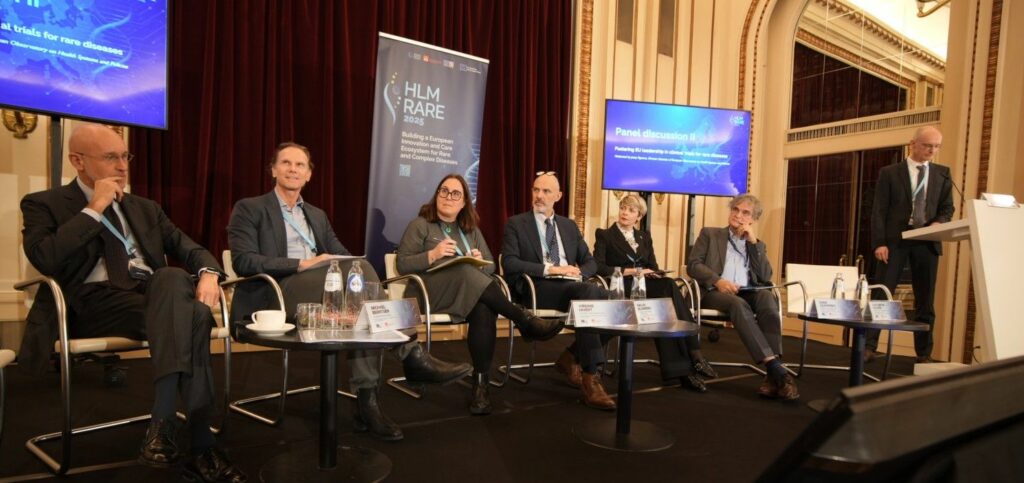
The High‑Level Meeting on European Research and Innovation for Rare Diseases (HLM Rare 2025) took place in Brussels from 9–11 December 2025. Over three days, EU policymakers, patient advocates, clinicians, researchers, industry representatives and payers worked together on the emerging Declaration on the European Innovation and Care Ecosystem for Rare and Complex Diseases. The meeting highlighted the crucial role of European Reference Networks (ERNs) and other key actors in shaping this initiative.
Organised under the leadership of the Brains for Brain Foundation, HLM Rare 2025 followed three themes that mirror the Declaration’s roadmap for priority action and the wider EU policy context set out in the Draghi, Letta, Heitor and Niinistö reports.
Day one focused on research and innovation, day two on EU‑wide infrastructure and skills, and day three on policy and funding. Across all sessions, speakers stressed that rare and complex diseases must be treated as a shared European responsibility.
Alongside institutional and expert perspectives, HLM Rare 2025 consistently brought the focus back to people living with a rare disease. As MEP Vlad Voiculescu put it, “why don’t we make the voice of people living with a rare disease so loud that the Commission and Parliament cannot avoid to hear it. We need to be precise in what we ask and we know what the community needs.” For ERDERA Coordinator Daria Julkowska, this captured the spirit of the discussions: political momentum around the Declaration will only translate into change if concrete asks are shaped and driven by the rare‑disease community itself, with initiatives like ERDERA helping to turn those asks into practical, coordinated action.
From the outset, the meeting highlighted the role of actors such as the European Rare Diseases Research Alliance (ERDERA) as a practical way to move from political vision to implementation. As Julkowska underlines, “no country alone can meet the scale and urgency of the rare disease challenge. Ringfenced support and budget in the forthcoming Multiannual Financial Framework (MFF) should not be a wish, should be a reality! What the EU needs now is wider collaboration, closer coordination, and more sustained investment in research and health systems”.
Clinical research, ERDERA and the European roadmap
Discussions in Brussels focused on how to make this ecosystem tangible. Participants looked at how incentives, regulations and funding streams could be better aligned with patient‑defined needs and with the specificities of rare and complex diseases. They stressed the importance of data, knowledge and expertise flowing safely across borders, including through interoperable registries, virtual platforms and the European Health Data Space.
ERDERA Coordinator Daria Julkowska joined the panel on fostering EU leadership in clinical trials for rare diseases. Drawing on experience from the Clinical Research Network in ERDERA, she pointed out that although Europe already has many centres of excellence, strong European Reference Networks (ERNs), robust registries and highly engaged patient organisations, most of these strengths remain fragmented.
“ERDERA represents a major milestone in this direction: it is Europe’s answer to fragmentation, a unique engine that brings together funders, researchers, clinicians, infrastructures, industry and – critically – patients themselves”, she noted. “It provides concrete tools that empower research, accelerate diagnosis and innovation, and strengthen clinical capacities including those of the European Reference Networks.”
A Declaration to connect policies, funding and care
The Declaration on the European Innovation and Care Ecosystem for Rare and Complex Diseases is a political and strategic commitment to fundamentally transform the rare‑disease ecosystem in Europe.
It responds to a changing EU policy landscape, including major reports by Mario Draghi, Enrico Letta, Manuel Heitor and Sauli Niinistö, and sets out a bold shared vision, clear strategic priorities and a roadmap for coordinated action.
In the short term, it foresees the establishment of a high‑level consultative group to develop a concrete, measurable EU Action Plan on Rare Diseases; in the medium to long term, it aims to accelerate progress through more timely and equitable access to treatments, universalised and better aligned newborn screening, and advanced diagnostics supported by data‑driven tools.
Over the three days in Brussels, each panel discussed, tested and refined the Declaration’s proposed priorities – ranging from comprehensive national rare‑disease infrastructure clusters in every Member State to innovative early‑access and financing models such as a possible European Guarantee Fund, as proposed in Enrico Letta’s report Much more than a market – so that the Declaration becomes not just a statement of intent, but a practical guide for joint action.
While the World Health Assembly has already adopted a global resolution on rare diseases, the European Declaration is still being finalised. With HLM Rare 2025 now concluded, Europe is closer to a common roadmap, yet the political process – including formal endorsement of the Declaration and agreement on a dedicated EU Action Plan – still lies ahead.
A European and global actor for rare diseases
The timing of HLM Rare 2025 underlined this dual European and global role. The meeting in Brussels ran in parallel with the International Clinical Research Networks Conference in Heidelberg, organised by ERDERA with the International Rare Diseases Research Consortium (IRDiRC) and Rare Diseases International (RDI). For Julkowska, this parallel agenda was symbolic: “Our presence at the HLM, alongside the organisation of the International Clinical Research Networks Conference with IRDiRC and RDI, shows that ERDERA is not just a European initiative – it is a global actor shaping the future of rare disease research and care. It demonstrates Europe’s leadership while opening the door to meaningful collaboration with low‑ and middle‑income countries.”
Reflecting on both events and on the wider ambitions of the Declaration, she added: “When we align our efforts, build shared infrastructures, and unite stakeholders under a common mission, we create the conditions for breakthroughs that no single system could achieve alone. The time is now to scale up, to connect, and to deliver for the 300 million people living with a rare disease worldwide.”