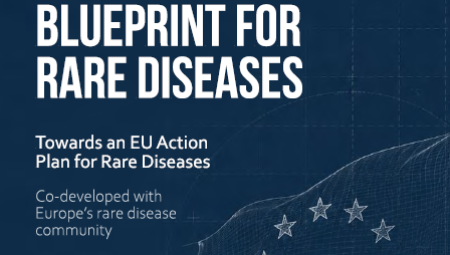
EURORDIS–Rare Diseases Europe has published the European Blueprint for Rare Diseases, setting out the rare disease community’s proposals for a future European Union Action Plan on Rare Diseases.
Launched on 15 October, the Blueprint starts from a clear premise: Europe has created valuable rare disease networks, programmes and infrastructure, but they do not yet operate as a sufficiently connected system.
The Blueprint identifies the European Rare Diseases Research Alliance (ERDERA) among these foundations, alongside the European Reference Networks, Orphanet, the orphan medicines framework and national rare disease plans. Its challenge is to connect this work so that progress in research, data and innovation translates more reliably into diagnosis, care and access to treatment.
A community-led framework for European action
The Blueprint was co-developed over ten months with people living with rare diseases and patient organisations, clinicians, researchers, public authorities and industry. The process included a core group of 36 experts and a survey with 236 responses from 33 countries.
A dedicated workshop held before the 13th European Conference on Rare Diseases & Orphan Products brought more than 150 participants together in Prague to refine the Blueprint. Discussions focused on what delivery would require in practice: clearer guidance, stronger coordination and accountability grounded in patient outcomes.
The completed Blueprint proposes 18 priority actions across diagnosis; specialised healthcare; integrated care and social inclusion; data; research; and access to medicines and medical devices. The priorities reflect stakeholder support, the added value of European cooperation and gaps left by existing initiatives.
As Jean Saslawsky, Chief Executive Officer of EURORDIS, said when the Blueprint was published, “Europe has built excellent networks, research programmes, data systems, specialist centres and a regulatory framework, but too often they sit beside one another rather than working as one system.”
In Saslawsky’s words, this will require “more strategic and coordinated decision-making to ensure that we turn Europe’s existing strengths and future innovations into tangible improvements in the lives of people living with a rare disease.”
Rather than replacing national rare disease plans, a future EU Action Plan would give them a common European framework, with shared goals, measurable targets, dedicated resources, patient partnership in governance and common monitoring arrangements.
Connecting policy, research and patient priorities
For the rare disease research community, the Blueprint addresses a persistent challenge: progress depends not only on individual discoveries, but also on the conditions that allow expertise, data, infrastructure and evidence to work across borders.
For very rare conditions, knowledge, clinical expertise, data and potential research participants may be dispersed across several countries. Progress therefore requires aligned priorities, interoperable data, shared infrastructure, coordinated funding and stronger connections between research, clinical practice and policy.
ERDERA brings many of these activities together through its work on research funding, clinical research, data, expertise services, training, acceleration and international alignment. A future EU Action Plan could provide a stable framework for connecting this work with the European Reference Networks, Orphanet, national programmes and other European initiatives.
Reflecting on this role, Daria Julkowska, ERDERA Scientific Coordinator, said: “Europe has reached a point where greater coordination is no longer simply desirable; it is essential. The Blueprint gives expression to a shared ambition, while ERDERA can help provide the research capacity, evidence and cooperation needed to carry that ambition forward.”
That ambition also places people living with rare diseases within the process of defining priorities, governing initiatives and assessing progress. Patient partnership is part of the connection the Blueprint seeks to establish between research, policy and real-world needs.
Roseline Favresse, who leads ERDERA’s work on Patient and Public Involvement (PPIE) in rare disease research, has described why this contribution matters to research quality. Patient perspectives, she said, are “vital in shaping, refining, and defining research projects in rare diseases”. Their lived experience can “guide research priorities, improve study designs, and ensure outcomes are meaningful to those living with rare diseases”.
Within ERDERA, patient involvement extends across research design, funding, training and governance. A coordinated European framework could help embed this partnership more consistently, while ensuring that progress is judged by changes that matter to patients and families.
Building momentum towards European action
The Blueprint is the rare disease community’s contribution to a future EU Action Plan; it is not an adopted European policy framework. EURORDIS is calling on the European Commission to use it in designing a future plan and on the Council and Member States to support that direction, including through a renewed Council Recommendation by the end of 2027.
Its publication follows several policy milestones. A European Parliamentary Research Service assessment mapped 31 possible measures, while a subsequent European Parliament draft report called for a comprehensive and binding framework. ECRD 2026 in Prague helped refine the Blueprint and strengthen agreement around the move towards implementation.
On 28 September 2026, the European Parliament’s Committee on Public Health adopted a legislative initiative report calling for an EU Action Plan and a future Regulation. According to EURORDIS, a plenary vote is expected in late November 2026. These developments do not constitute an adopted EU plan, but indicate that coordination is moving further into the formal policy process.
Other initiatives address parts of the rare disease landscape, including the proposed Biotech Act, pharmaceutical legislation, the Health Technology Assessment Regulation and the European Health Data Space. The Blueprint’s case is that none can, on its own, connect diagnosis, care, data, research, social inclusion and treatment access.
For ERDERA, the task is to ensure that research evidence, infrastructure and cross-border cooperation are ready to support the direction Europe takes.
Looking towards that next stage, Julkowska said: “A European Action Plan would give rare disease research a stronger common horizon. Our responsibility now is to keep building the connections that will allow knowledge, evidence and innovation to reach people, wherever in Europe they live.”
Readers can consult the full European Blueprint for Rare Diseases, explore its executive summary and 18 proposed priority actions, or visit ERDERA’s publication page.