
This year’s Rare Disease Day slogan, “More Than You Can Imagine”, speaks to both scale and invisibility: rare diseases affect millions of people, but their impact is not always recognised in everyday settings.
It also draws attention to what needs to be in place before research can move—common standards, clear rules, and workable arrangements for safe, lawful collaboration across borders.
That is the space ERDERA, the European Rare Diseases Research Alliance, is designed to fill. Co‑funded by the European Union under Horizon Europe and bringing together more than 170 public and private organisations across 37 countries, ERDERA connects funding, clinical research, data services, expertise and training provision, and scaling-up mechanisms so that work in one area supports the next step towards patient benefit. Now well into its second year, ERDERA has started disseminating early results from its activities.
Turning collective priorities into funded projects
In a partnership like ERDERA, funding is often the earliest visible sign of activity. It enables teams to form across countries, develop proposals and begin work that can be assessed and built on.
In December 2025, ERDERA announced its first funded portfolio under the Joint Transnational Call: 18 multinational preclinical therapy projects selected from 161 initial proposals, representing a combined budget of approximately €29 million. These projects span a wide variety of diseases and have a strong translational focus, aiming to speed up the development of new therapy options for rare disease patients.
Soon after, ERDERA launched the 2026 Joint Transnational Call on “Resolving unsolved cases in rare genetic and non‑genetic diseases”, welcoming proposals aimed at delivering diagnostic clarity for unsolved and clinically complex conditions.
Behind these announcements sits work that, though less visible, is essential for joint funding to operate: agreeing call topics that reflect both scientific opportunity and unmet need, aligning procedures and timetables across participating funders, and applying governance arrangements intended to keep decision‑making transparent and robust.
In rare disease research—where patient groups are often small and expertise can be distributed across countries—those steps influence whether studies are feasible in more than one setting, whether data and outcomes can be compared, and whether findings are more likely to be usable beyond a single site.
10 000 harmonised datasets for unsolved cases
Rare disease data is often available, but not necessarily usable. Records may sit in different hospitals, registries, biobanks and research studies, captured in different formats and languages and using different definitions. That fragmentation makes cross‑cohort analysis difficult without substantial preparation and clear governance.
In a February 2026 update, ERDERA reported that it had brought together 10 000 harmonised genomic and phenotypic datasets from unsolved rare disease cases across Europe into a secure, standardised resource.
Hosted within the ERDERA Diagnostic Research environment, the resource is intended to support clinicians and researchers by making datasets more consistently structured and comparable.
Governance is a key part of making the resource usable in practice. Tübingen University Hospital expert Holm Graessner, who also leads the Diagnostic Research Programme in ERDERA, notes: “We have a responsibility towards consent, confidentiality and regulatory requirements, but we also have the opportunity to help institutions reach faster, more reliable diagnoses through responsible data sharing. This aim balances the imperative to share with the duty to protect.”
ERDERA Scientific Coordinator Daria Julkowska also frames this as a necessary condition for progress at scale: “ERDERA has built the foundations of a European infrastructure for answers and is now advancing towards a federated model, empowering national capacities while connecting them into a seamless ecosystem where knowledge can flow without data having to move.”
Clinical research built for the reality of small numbers
Small cohorts in rare diseases make evidence generation especially demanding: study designs and analyses need to reflect small and heterogeneous populations while still producing evidence that clinicians, regulators and health systems can use.
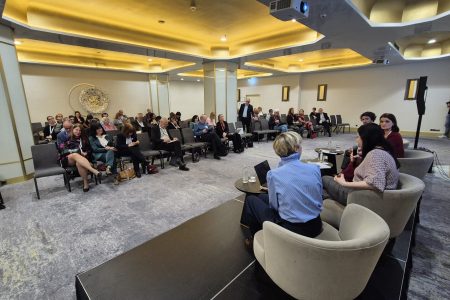
ERDERA’s Clinical Research Network is designed to link European Reference Networks, national diagnostic centres and undiagnosed disease programmes, and to support diagnostic research, outcome research and innovative therapies. In December 2025, ERDERA co‑organised the second International Conference on Clinical Research Networks with Rare Diseases International and the International Rare Diseases Research Consortium, bringing clinicians, patient leaders, regulators and researchers together to focus on practical steps for running research across borders.
At the conference, Franz Schaefer of Universitätsklinikum Heidelberg, and co‑lead under ERDERA’s Clinical Research Network service, underlined that “Real‑world evidence is powerful only when collected according to common standards and trusted by regulators.”
From results to use in practice: expertise, translation, and participation
For rare disease projects, progress often depends on decisions taken early: methods that stand up to scrutiny, evidence that can be interpreted across settings, and regulatory and ethics planning that is proportionate.
ERDERA’s Expertise Services Hub is intended to provide researchers involved in ERDERA actions with access to mentoring, regulatory and ethics support, as well as methodological support, including guidance on clinical trial design, epidemiology, real‑world data use and advanced analytics.
ERDERA has also established the ERDERA Accelerator, including a Public–Private Collaboration Accelerator, a structured support service for early translational projects spanning areas such as preclinical development, regulatory science and market access. In parallel, the Training and Education service at ERDERA aims to strengthen shared capability so that participation is more practical for clinicians, researchers and patient advocates.
Finally, its International Alignment service includes National Mirror Groups, intended to connect national communities with European‑level planning. ERDERA reported 20 National Mirror Groups established by January 2026, involving close to 250 organisations, with most of them reporting national dissemination of ERDERA opportunities and progresses.
ERDERA also brings an international dimension through the International Rare Diseases Research Consortium (IRDiRC), whose Scientific Secretariat is supported through ERDERA. In March 2025, ERDERA, IRDiRC and the BLACKSWAN Foundation jointly organised the RE(ACT) Congress and IRDiRC Conference in Brussels, bringing together researchers, patient advocates, funders and policymakers to discuss priorities such as early diagnosis, data sharing and advanced therapies.
What “More Than You Can Imagine” points to in practice
For ERDERA, the Rare Disease Day slogan—coordinated globally by EURORDIS-Rare Diseases Europe—is a useful prompt to focus on what enables research to be done well: standards that make work comparable, governance that can be explained and audited, and support that helps studies and datasets move from “feasible” to “robust”.
The reported advances show collaborative activity across funding, diagnostic research data and clinical research coordination, alongside services intended to strengthen project design and regulatory readiness.
The value for patients and communities relies on whether these parts work together in day‑to‑day practice: whether more teams can take part, whether evidence becomes more interpretable across countries, and whether earlier diagnosis and better options become more achievable over time.