



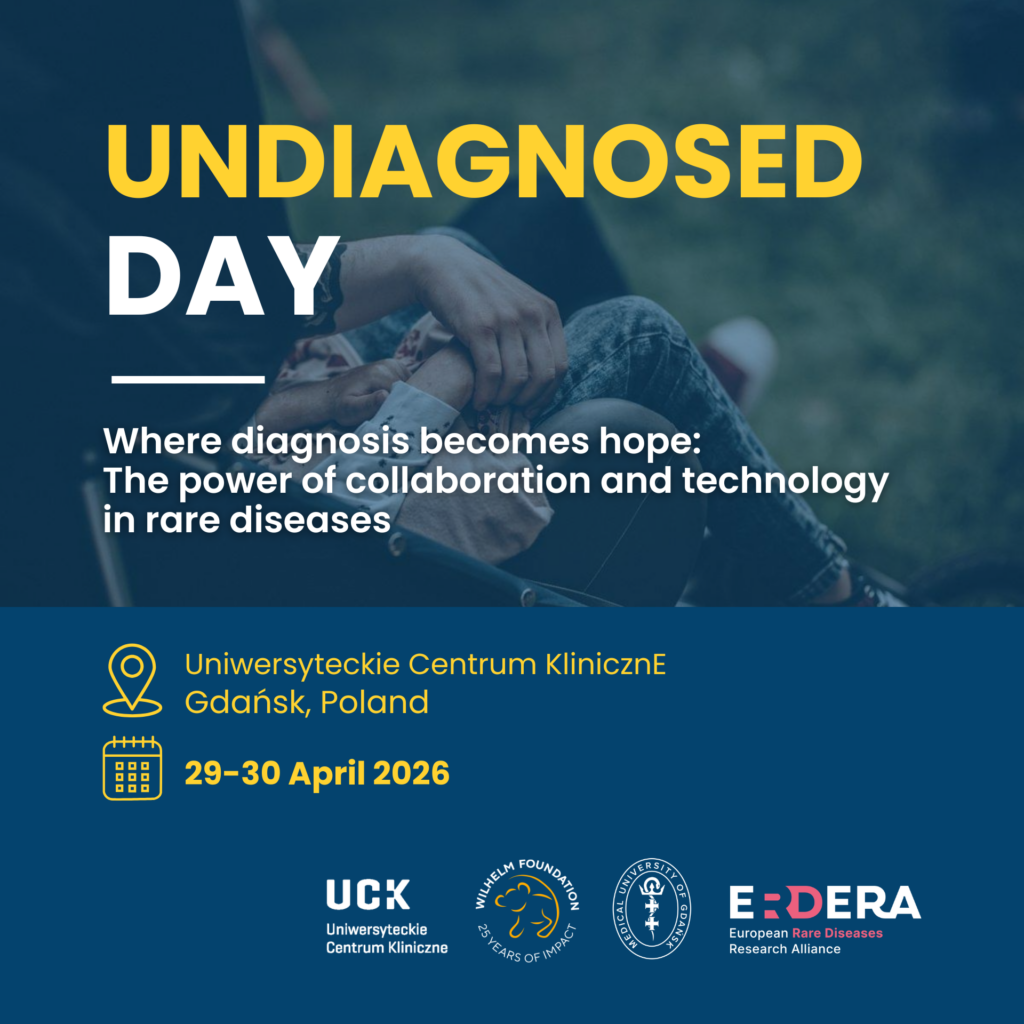
Undiagnosed Day 2026 is a two‑day, clinician‑led meeting in Gdansk bringing together specialist clinicians, clinical geneticists and invited experts to support phenotype‑led diagnosis through live case discussion, shared clinical reasoning and practical exchange.
The event is organised by the European Rare Diseases Research Alliance (ERDERA); the Wilhelm Foundation; the Medical University of Gdansk (GUMed); and the University Clinical Centre in Gdansk (UCK).
Although it draws on the same collaborative spirit as international Undiagnosed Hackathons, where patients who have previously failed to receive a diagnosis through standard genetic testing are re-analysed using more advanced techniques, the Gdansk event is designed around specialist clinical assessment and multidisciplinary discussion with patients and families present.
What to expect
The meeting will focus on practical approaches to phenotyping and diagnosis in undiagnosed conditions, including how to define next steps when a diagnosis remains uncertain, and how to strengthen pathways and collaboration around undiagnosed care.
Preliminary Programme
Wednesday April 29th, 2026 – CLOSED EVENT
This session is not open to the public.
Thursday April 30th, 2026 – OPEN EVENT
Format: In‑person – day one closed round table; day two open conference
Venue: University Clinical Centre in Gdańsk (UCK), Centre of Invasive Medicine (CMI), Auditorium im. prof. Zdzisława Kieturakisa (nr 2/DD/04)
Times are in CEST.
Registration for Day 2 is available here.
09:00–09:30 – Opening
- Prof. Tomasz Stefaniak – Director, UCK Hospital, Gdansk
- Prof. Michał Markuszewski – Rector, Medical University of Gdansk
- Prof. Jolanta Wierzba – Center for Rare Diseases, Gdansk
- Prof. Maria Mazurkiewicz‑Bełdzińska – Department of Developmental Neurology
- Ms. Maja Bartoszewicz‑Moritz – Center for Rare Diseases – Patient Council Representative, Gdansk
09:30–09:45 – Introduction
- Ms. Helene Cederroth – Wilhelm Foundation
- Dr. Daria Julkowska – ERDERA
09:45–11:15 – Session I: Modern diagnostics in undiagnosed diseases
Modern diagnostics in undiagnosed diseases brings together clinical genetics, international research leadership and health‑system perspectives to show how the diagnostic pathway is evolving – from careful phenotyping and functional genomics to scalable data platforms and cross‑border collaboration.
Speakers will highlight the global IRDiRC view on accelerating answers, a practical diagnostic pathway using Cornelia de Lange syndrome as an example, the current rare‑disease landscape in Poland, emerging platforms supporting undiagnosed rare conditions (URC) and diagnostic capability‑building, and how improved diagnostics translate into real‑world care options for patients and families.
Session Chairs: Prof. Maurizio Scarpa; Prof. Krzysztof Szczałuba
- Dr. David Pearce – “From Undiagnosed to Rare”; Chair, International Rare Disease Research Consortium (IRDiRC)
- Prof. Frank Kaiser – Diagnostic Pathway of Cornelia de Lange Syndrome; Institute of Human Genetics, Universitätsklinikum Essen (AöR), Essen, Germany
- Prof. Monika Gos – Rare disease situation in Poland; Institute of Mother and Child, Warsaw, Poland
- Prof. Katrin Ounap – Data platforms for URC and diagnostic capabilities; ERN ITHACA / ERDERA; University of Tartu, Estonia
- Prof. Siddharth Banka – Diagnostics and care possibilities; Manchester Rare Conditions Centre
11:15–11:45 – Coffee break
11:45–12:45 – Session II: Clinical cases with and without diagnosis
Clinical cases with and without diagnosis is a case‑based session illustrating the real‑life diagnostic journey in rare and undiagnosed conditions – what enables a breakthrough, what still blocks answers, and how precision medicine can (and cannot yet) change management.
Following an introduction to precision medicine, four cases will be discussed – two solved (each reflecting a long diagnostic odyssey) and two unsolved – to highlight practical decision points, multidisciplinary collaboration and the added value of advanced genomics, re‑analysis and data sharing. The session is designed to be interactive, focusing on transferable lessons for clinicians and the patient community: how to shorten time to diagnosis, avoid missed opportunities and define next steps when a diagnosis remains elusive.
Session Chairs: Ms. Shirlene Badger; Dr. David Pearce
- Prof. Saumya Jamuar – Introduction to precision medicine; Senior Consultant in the Genetics Service at KK Women’s and Children’s Hospital
- Prof. Hayane Akopyan – Case report; National Academy of Medical Sciences of Ukraine, Kyiv, Ukraine
- Dr. Aleksandra Bodetko – Case report; Department and Clinic of Pediatrics, Endocrinology, Diabetology and Metabolic Diseases, Medical University of Wroclaw, Poland
- Dr. Agnieszka Madej‑Pilarczyk – Case report; Department of Medical Genetics, The Children’s Memorial Health Institute, Warsaw, Poland
- Ms. Kornelia Polat – Case report; Student Scientific Circle “Rare Diseases”, Medical University of Gdansk, Poland
12:45–13:45 – Lunch
13:45–15:15 – Session III: What to do when there is no diagnosis
What to do when there is no diagnosis focuses on practical, ethical and system‑level actions when a diagnosis is delayed or never achieved. The session connects clinical management (how to organise comprehensive, coordinated care based on needs rather than labels), international practice and patient–family partnership (how “science projects” and collaborative pathways can be pursued responsibly).
It will also address privacy and data governance while searching for answers, and the caregiver burden and quality of life – with and without a confirmed diagnosis – so that support, communication and services can be planned proactively. The overall aim is to equip participants with a “diagnosis‑agnostic” approach: clear next steps for care, research participation and family support, even when certainty remains out of reach.
Session Chairs: Prof. Frank Kaiser; Dr. Tomasz Grybek
- Prof. Jan Domaradzki – Caregiver burden and quality of life with and without diagnosis; Poznan University of Medical Sciences, Poznan, Poland
- Prof. Jolanta Wierzba / Dr. Karolina Śledzińska – Diagnosed – and what’s next; comprehensive and coordinated care; Center for Rare Diseases, Gdansk, Poland
- Prof. Gareth Baynam – Diagnosed – and what’s next; comprehensive and coordinated care – ONLINE; Rare Care Centre, Perth Children’s Hospital, Australia
- Ms. Shirlene Badger – “Science projects”: ethics of patient engagement and collaboration
- Ms. Mary Jane Dykeman – Protecting privacy while pursuing answers for undiagnosed children; INQ Law | Health AI, De‑ID & Applied Innovation | EpiSign Chai
15:15–15:45 – Coffee break
15:45–17:15 – Session IV: International cooperation and health data management
International cooperation and health data management explores how cross‑border collaboration, shared registries and EU‑level infrastructures are reshaping the rare and undiagnosed disease landscape – making data findable and usable, accelerating diagnostics and enabling more consistent care across countries.
The session connects perspectives from ERDERA’s undiagnosed community, EU coordination and long‑term strategy for rare diseases, lessons learned from flagship initiatives such as SOLVE‑RD and the role of ERNs. Speakers will also highlight advances in paediatric neurology diagnostics in Poland, showing how international frameworks translate into real clinical capacity and patient benefit – while keeping ethical boundaries, privacy and trust at the centre.
Session Chairs: Prof. Monika Gos; Dr. Karolina Śledzińska
- Prof. Laima Ambrozaityte – [Speech title tbc]; Dept. of Human and Medical Genetics, Institute of Biomedical Sciences, Human Genome and Regulome Research Group, Translational Health Research Institute, Faculty of Medicine, Vilnius University – ERDERA Undiagnosed group
- Prof. Maurizio Scarpa – Coordination and cooperation at the EU level – how to build the future of rare diseases in Europe based on the past; Brains for Brain Foundation; Dept. of Women’s and Children’s Health, University of Padova, Italy
- Dr. Holm Graessner – When technology meets ethics – the limits and future of transforming diagnosis into therapy for rare diseases; Coordinator of ERN‑RND (Tübingen) and the SOLVE‑RD project “Solving Unsolved Rare Diseases”
- Prof. Maria Mazurkiewicz‑Bełdzińska – Advances in diagnostics of paediatric neurology in Poland
17:15–17:45 – Closing remarks
Contact
For practical questions, please write to global2026@undiagnosed-day.org.