1:1

blankpublication

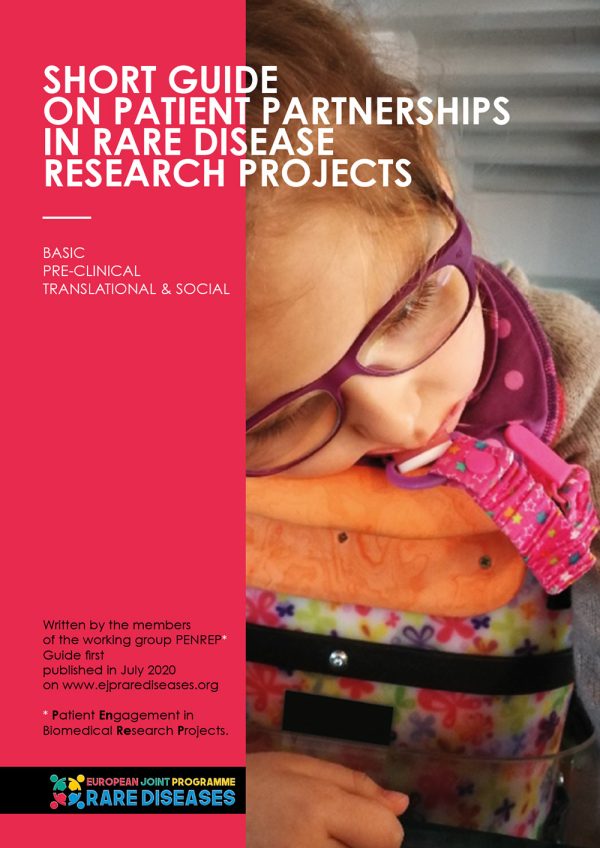
This practical “Short Guide on Patient Partnerships in Rare Disease Research Projects” was created by the European Joint Programme on Rare Diseases (EJP RD) to show scientists, funders and patient organisations how to build meaningful, two-way collaborations in basic, pre-clinical, translational and social-science studies.

It explains why early and sustained patient involvement boosts relevance, impact and funding success, and provides concrete examples, check-lists and real-life testimonials to help consortia avoid common pitfalls and design truly patient-centred projects.

Key publication details

• Full title: Short Guide on Patient Partnerships in Rare Disease Research Projects – Basic, Pre-clinical, Translational & Social
• Authors: Working Group “Patient Engagement in Biomedical Research Projects” (PENREP), chaired by EURORDIS and convened under the European Joint Programme on Rare Diseases (EJP RD).
• Scientific reviewers: Prof. Hanns Lochmüller (CHEO Research Institute, Canada) and Prof. Danny Huylebroeck (KU Leuven, Belgium).
• First publication date: July 2020
• Publisher/Imprint: European Joint Programme on Rare Diseases (EJP RD), Paris (FR).

Year of publication

2020

Author

Working Group “Patient Engagement in Biomedical Research Projects” (PENREP), chaired by EURORDIS and convened under the European Joint Programme on Rare Diseases (EJP RD).

You might also be interested in

Young advocates met in Paris from 23–25 April 2026 for the second ERDERA Training for Young Advocates for Rare Diseases, focused on advocacy, clinical research, patient rights and partnership in paediatric rare disease research.
Two expert‑led facilitation windows linked to EJPRD‑developed MOOCs, give learners the opportunity to engage directly with specialists in health data governance and translational research for rare diseases.
This study investigates possible measures that could be taken at EU level to address these challenges. It finds significant European added value in harmonising coordination and access across the 27 Member States, mainly in terms of improved diagnostic tools and availability of medical treatment, better health outcomes, particularly lower infant mortality, and improved well-being of family members and caregivers.